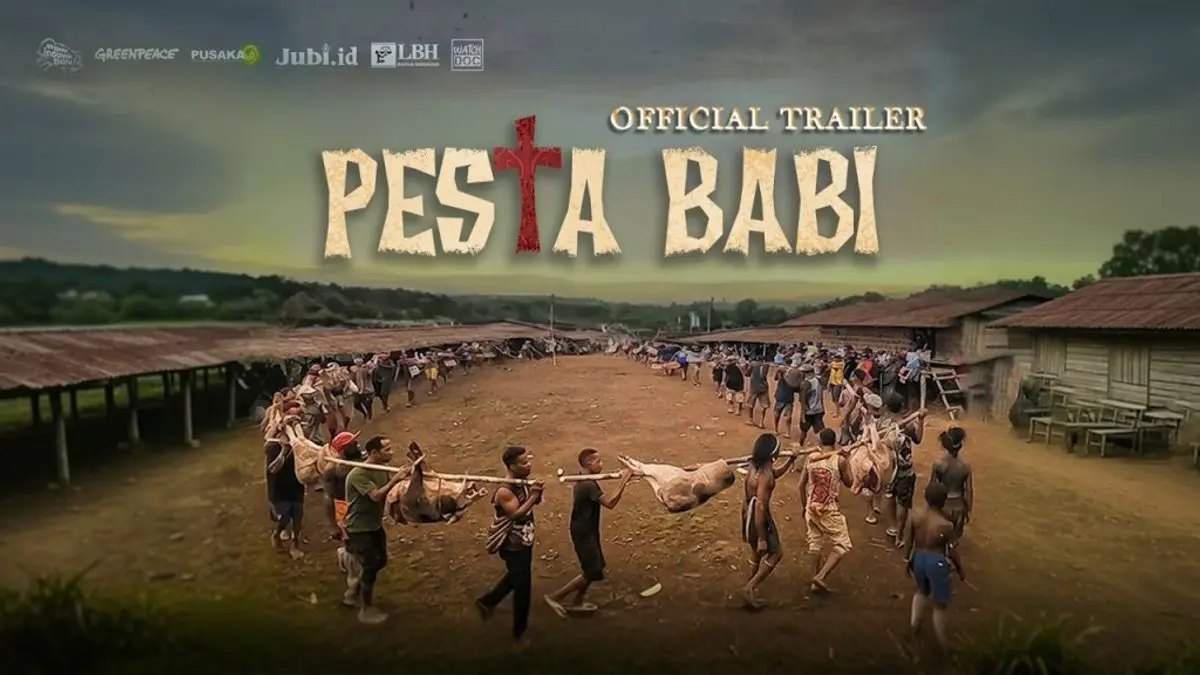
THE PIG FEAST: Indigenous Resistance Against Colonialism of Food and Energy in Papua
The tropical rainforest of Papua is one of the last remaining green fortresses on planet earth. However, behind its beauty and natural wealth, a major irony is unfolding. Through an ambitious project labeled as the National Strategic Project (PSN), the Indonesian government is targeting the clearance of more than 2.5 million hectares of indigenous ancestral forests in Southern Papua for large-scale food and energy industries, such as palm oil (biodiesel), sugarcane (bioethanol), rice fields, and cattle ranching.
For the indigenous Papuan communities, this project is not "development," but a clear form of modern colonialism that robs them of their living space, destroys their civilization, and threatens their existence.
1. Symbols of Resistance: 1,800 Crimson Crosses and Customary Prohibitions of the Auyu Tribe
In Boven Digoel Regency, Frankie Woro and the residents of the Auyu tribe are not staying silent as they watch their ancestral forests being targeted by palm oil corporations. As a form of resistance, they prepared a massive 17-meter-long cross made from native ironwood from the swamps. This cross became part of the "Crimson Cross" movement combined with a customary palang (prohibition marker)—a sign of strict prohibition for the state or companies to enter their ancestral territories.
To date, around 1,800 crimson crosses have been systematically planted in sago groves and sacred places across Southern Papua. For the Auyu tribe, if state laws no longer side with them, they surrender to customary laws, their ancestors, and God. They emphasize that the land is an unalienable heritage entrusted by the Creator that they must protect, even if it costs them their lives.
2. The Misery of Victims on the Frontline: The Destruction of Forests and Swamps of the Marin Tribe
In the Ilway District of Merauke, Yasinta Moyen and the women of the Marin tribe have already felt the bitter reality of eviction firsthand. In July 2024, hundreds of heavy machinery suddenly arrived at Wanam Port without any dialogue or consent from the local indigenous landowners.
The forests and swamps that have always been their "natural supermarket" where they hunt wild boar, deer, and process sago are now being rapidly cleared to build a 135-kilometer straight road and rice fields. This eviction forces the indigenous people to become mere spectators on their own land. Meanwhile, sweet promises of "land optimization" from the government actually make local farmers like Filomina lose money due to the high capital costs of modern farming (fertilizers, pesticides, and tractor rentals) that do not match the harvest selling price.
3. Behind the Project: The Grip of Corporate Oligarchy and Militarism
This documentary uncovers the big actors behind this massive forest clearing. The rice field creation and biodiesel projects are carried out by a massive contractor corporation, Jhonlin Group, owned by Andi Syamsuddin Arsyad (Haji Isam), who imported thousands of excavators to Papua. Meanwhile, the sugarcane and bioethanol concessions are controlled by the corporate network of the Fangiono family (Merauke Sugar Group, FAP Agri) working in close business alignment with global agribusiness giant Wilmar International.
This mega food project is strictly guarded by the military through non-combat operations (military operations other than war). The establishment of new military posts (such as the Development Territorial Infantry Battalions) right next to corporate concessions triggers deep trauma for local residents, who have lived under the shadow of military violence for the past 60 years. The ratio of soldiers in Papua has now reached 1 personnel for every 100 Papuans, a density vastly disproportionate to the national average.
4. A Cycle of Food Estate Failures Since the Suharto Era
The film's narrative also reminds us of the dark historical record of the "Food Estate" in Indonesia. The ambition to create food barns by sacrificing forests has proven to have a repeated track record of failure:
-
The Suharto Era (1996): The 1-million-hectare Peatland Project (PLG) in Central Kalimantan failed completely, triggering massive forest fires and perpetual haze disasters.
-
The Susilo Bambang Yudhoyono Era (2010): The Merauke Integrated Food and Energy Estate (MIFEE) project, which also ended up abandoned.
-
The Joko Widodo & Prabowo Subianto Era: The failure of the cassava project in Gunung Mas, Central Kalimantan.
Even though the chain of failures in peatlands and cassava is clear, the government is repeating the exact same blueprint in Papua on a much more massive scale to fulfill urban energy blend ambitions (E10 bioethanol and B50 biodiesel).
5. Customary Mobilization Through the Muyu Tribe's "Pig Feast"
In the remote interior of Boven Digoel, bordering Papua New Guinea, Willem Kimko and the Kimko Jinibjo clan took a different path. After waiting for 10 years to raise pigs that were released wild into their customary forest, they held a customary ritual called Awon Atatbon or the Pig Feast.
This pig feast is not just a party or a regular celebration. Behind this rare Melanesian tradition lies a mission of social consolidation and reciprocal economic exchange between clans. Through this feast, the clans of the Muyu tribe build alliances, strengthen cultural defense, and reinforce the ownership of their forest territory before heavy machinery and corporations surround their land.
Conclusion
The documentary closes with a deep reflection on cultural destruction (ethnocide). If the extinction of the Aborigines in Australia or the Native Americans in America is considered past history, a similar process of systemic dispossession is actively happening today against the Melanesian people in Papua. When the forest—which is the mother, home, and identity for Papuans—is destroyed for the fuel tanks of city vehicles, an entire human civilization is pushed toward extinction.
Watch the full video on the Redaksi JubiTV YouTube channel: PESTA BABI: Kolonialisme di Zaman Kita.